5.56 vs .223: what actually matters
They are the same size, they chamber in the same rifle, and one of the two substitutions is a bad idea. The reason is not the cartridge: it is the chamber it lands in.
By TAS8 min read
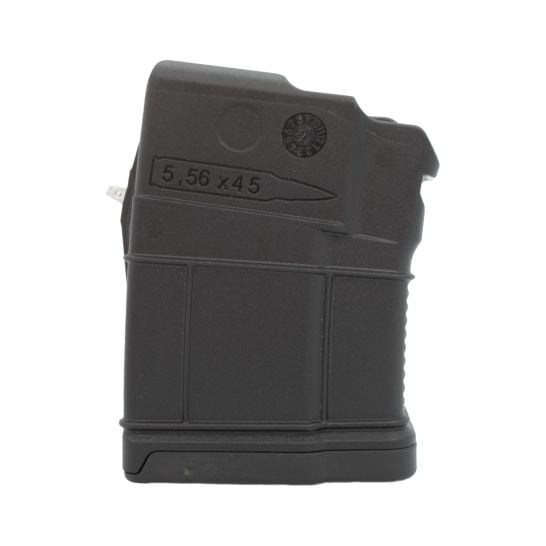
External dimensions of the two cartridges are effectively identical. Case length, shoulder, rim, bullet diameter: a 5.56 round will chamber in a .223 rifle without any resistance to warn you, and the rifle will fire it. That is precisely the problem. The safety question here is not whether the ammunition fits. It is what pressure the combination produces once the primer goes.
Two things differ, and they compound
Pressure spec. SAAMI holds .223 Remington to a maximum average pressure of 55,000 psi. The NATO specification for 5.56 is higher, and it is also measured differently. NATO takes its reading at a different point on the case than SAAMI does, so the two numbers are not directly comparable in the way forum posts usually compare them. The practical summary is the one that matters: military-spec 5.56 is a hotter load than commercial .223, by a margin large enough that SAAMI publishes them as separate cartridges.
Chamber leade. This is the larger factor and the one almost nobody mentions. The leade (the short unrifled section ahead of the case mouth, also called freebore) is roughly twice as long in a 5.56 NATO chamber as in a SAAMI .223 chamber. A longer leade lets the bullet accelerate before it engages the rifling. A short one loads the bullet into the lands almost immediately, which spikes pressure.
Put hot ammunition into a tight chamber and the two effects stack. You are not adding a small margin to a large one; you are adding a pressure excursion to a load that was already at the top of the commercial window. Depending on the rifle, the lot and the temperature, the result ranges from accelerated wear and hard extraction to pierced primers, blown case heads and a damaged rifle.
The reverse (.223 in a 5.56 chamber) does the opposite. The longer jump to the rifling drops peak pressure rather than raising it. You may lose a little velocity and, in a precision rifle, some accuracy to the longer bullet jump. Neither of those is a safety issue.
Read the barrel, not the receiver
The chamber is cut into the barrel, so the barrel is what tells you the truth. On an AR-15 the marking is usually on the barrel extension area near the front sight base or on the barrel itself under the handguard; on a bolt gun it is normally on the barrel ahead of the receiver ring.
- Stamped 5.56 NATO: shoot either. This covers most AR-15s sold in the United States.
- Stamped .223 Rem: .223 only. Common on bolt-action varmint rifles, some older ARs and a number of budget-build barrels.
- Stamped .223 Wylde: both are safe. More on this below.
- No stamp, or a stamp you cannot read: do not guess. Call the manufacturer with the serial number, or have a gunsmith cast or gauge the chamber. “It is probably 5.56” is not a chamber identification.
An upper receiver marked “MULTI CAL” tells you nothing about the chamber. Neither does the magazine, the lower, or what the previous owner said. Only the barrel.
What .223 Wylde actually is
Bill Wylde’s chamber is a hybrid, and it exists to end this exact argument. It uses the longer 5.56 NATO leade, so full-pressure 5.56 stays within spec, paired with a tighter, more concentric freebore than a mil-spec chamber. That combination is why Wylde barrels have a reputation for shooting match ammunition well while still eating military surplus.
If you are buying a barrel and you want one chamber that does not require you to think about the headstamp again, Wylde is the answer. It is not a different cartridge and there is no such thing as .223 Wylde ammunition: it is a chamber, and you feed it .223 or 5.56.
The part that actually changes your groups: twist
For most shooters, the headstamp argument is settled in thirty seconds by reading a barrel, and then the decision that genuinely affects results is twist rate and bullet weight.
Rifling twist stabilises a bullet by its length rather than its weight, but weight is the number printed on the box, so that is what everyone uses as the proxy. A 1:12 barrel is happy with 55 grain and will not stabilise much beyond it. A 1:9 handles 55 through the high 60s. A 1:7, the standard on most modern ARs, will shoot 55 grain and will also stabilise 77 grain match bullets, which is the whole reason the military went there.
So: federal-xm193-5-56-nato at n/a a round in the 1,000-round case is the default high-volume 5.56 load, and it is 55 grain M193 spec. It shoots correctly out of essentially every AR twist rate in circulation. When you want the same rifle to hold a group at distance, black-hills-77gr-tmk-5-56-nato is the other end of the shelf: a Sierra Tipped MatchKing that needs 1:8 or faster, and costs several times as much per round for reasons you can measure on paper.
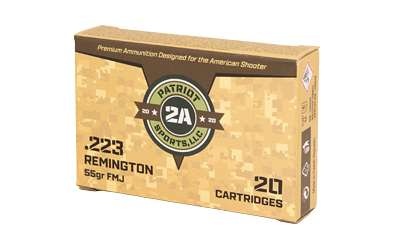
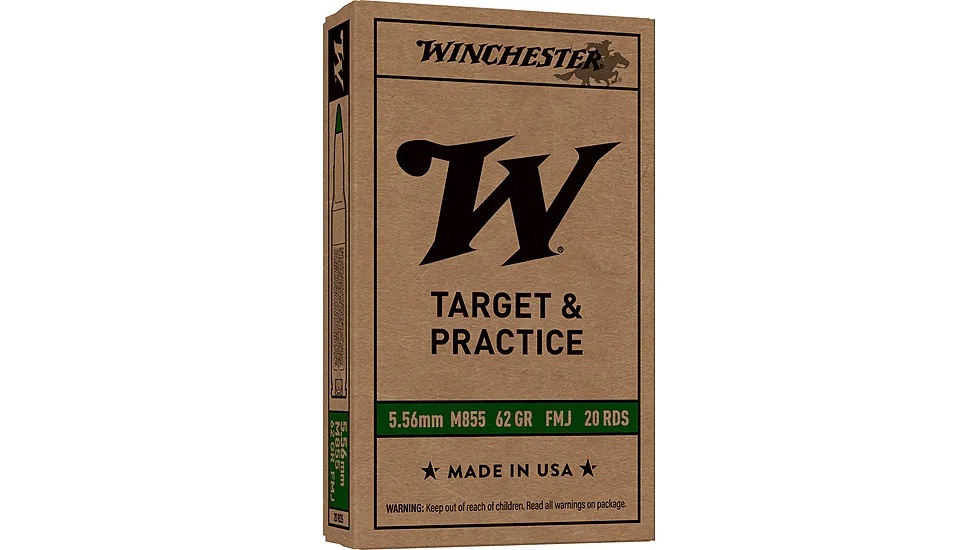
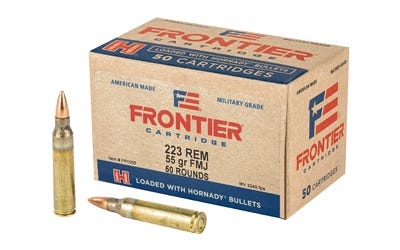
If your rifle is genuinely .223-only, winchester-usa-223-remington at n/a a round is standard commercial pressure and safe in every .223 chamber, and hornady-frontier-223-remington puts a better bullet in Lake City brass for very little more.
M855, steel core and range rules
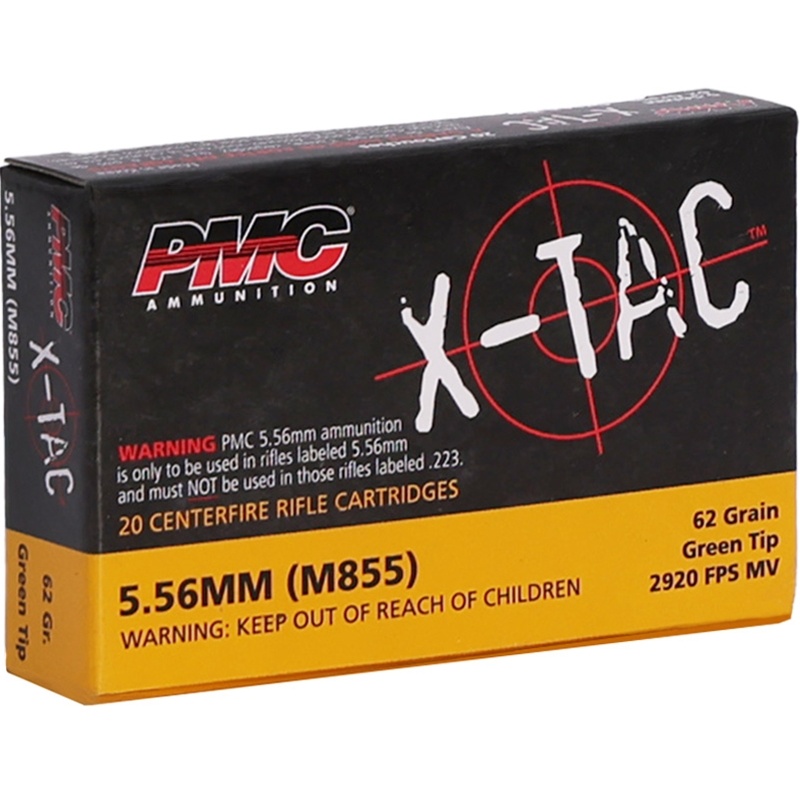
The other thing sold as “5.56” that catches people out is M855: the 62 grain green-tip load with a steel penetrator tip. It is not armour-piercing in the legal sense, but the steel tip damages steel targets and many indoor ranges ban it outright, along with steel-cased ammunition, because of backstop wear and spark risk. Check the range’s rules before you turn up with a case of it, and note that the 62 grain option in pmc-x-tac-5-56-nato is that load, not an alternative to it. A plain 55 grain FMJ, or a genuine soft point such as the 62 grain in hornady-frontier-223-remington, avoids the argument entirely.
What to do with a mixed range bag
The failure mode is almost never someone deliberately loading the wrong round. It is a .223 bolt gun and a 5.56 AR in the same car, loose rounds in a pocket, and a magazine that got topped off from the wrong box.
- Keep one caliber on the bench at a time.
- Never decant ammunition into an unlabelled container. Rounds live in the box they came in, with the headstamp and lot code readable.
- If you own a .223-only rifle, do not keep 5.56 in the same bag as it. Separate bags, or separate days.
Our full handling guidance, including the wider table of commonly confused cartridge pairs, is on product safety. It is worth five minutes even if you have been shooting for thirty years, because the pairs that are dangerous are not the ones that feel dangerous.
Buying, in one line each
- 5.56 chamber: buy 5.56. It is usually cheaper per round than .223 and you lose nothing. Browse 5.56 NATO.
- .223 chamber: buy .223, and only .223. Browse .223 Remington.
- .223 Wylde: buy whichever is cheaper per round today, and buy match ammunition when you want to see what the barrel can really do.
A 20-round box of XM193 runs n/a and the 1,000-round case runs n/a: the same ammunition, a quarter cheaper per round. Which of those is the right purchase is a separate question, and we worked the maths on it here.
Shop this caliber
Live prices for what is in stock right now.