.40 S&W ammo buying guide
The cartridge that dominated American law enforcement in the 1990s now sells at a price that makes it the value play in a full-size pistol — if you understand what the cheap 180 grain loads are and are not for.
By TAS6 min read
.40 S&W was built to split the difference between 9mm and .45 ACP for police departments, and for twenty years it did exactly that. Then 9mm hollow points closed the performance gap, duty armories switched back, and the cartridge that once cost a premium now sits on the shelf as one of the cheapest full-size centerfire rounds in the shop. The question in 2026 is not whether .40 works — it does — but where the bargain 180 grain loads shine and where they do not.
Short version: .40 is the value play if you already own the gun and you shoot a full-size pistol. The economics favour practice volume; the ballistics are settled. Choose between 180 and 165 grain, verify a hollow point, and buy the case.
What .40 S&W is for
The cartridge is a shortened 10mm Auto case with a .400-inch bullet, introduced in 1990 for law-enforcement pistols that had to fit smaller hands than the 10mm frame allowed. It delivers a heavier bullet than 9mm at similar or slightly higher velocities, from full-size double-stack pistols with 15- to 16-round magazines. That is still a useful combination for range shooting, home defence, and any purpose where recoil is a price worth paying for a heavier projectile.
The duty market moved on — most American police armories went back to 9mm through the 2010s — and that exodus is exactly why the shelf is cheap now. Production did not stop; the customers changed. What remains is a mature cartridge with a deep brass inventory, a settled load menu, and pricing that rewards the shooter who is willing to ignore the fashion argument.
It is a snappier round than 9mm — a sharper impulse rather than a push — and small subcompact .40 pistols are unpleasant and slow to reacquire. If the gun is a 4-inch service pistol or a full-size compact, the recoil is easily managed by anyone who practises. For the capacity-versus-power argument in full, see 9mm vs .45 ACP, which explains why the market moved the way it did.
The load menu
| Load | Velocity | Character | Best at |
|---|---|---|---|
| 180 gr FMJ | 950–1,000 fps | The default; moderate, flat recoil | Practice and volume, by the case |
| 165 gr FMJ | 1,050–1,150 fps | Snappier, a touch more muzzle blast | Shooters who prefer the lighter bullet |
| 180 gr JHP | 950–1,000 fps | Duty standard; deep, consistent penetration | Carry and home defence |
| 165 gr JHP | 1,050–1,150 fps | Faster, slightly harder on the pocket gun | Carry, from 4" barrels |
Two weights cover the market. 180 grain is the duty standard and the right default: most factory defensive loads in .40 are 180 grain, so practising at the same weight keeps recoil impulse and point of impact consistent with what you carry. 165 grain trades a little bullet weight for velocity and is a legitimate alternative if you shoot it better — which you will only know by shooting both.
There is also a soft spot in the market for 135 and 155 grain defensive loads, built for short-barrel expansion. They exist for subcompact pistols that cannot use the velocity of the heavier bullets, and they are worth considering only if that is the gun you own. In a full-size pistol, 180 grain remains the answer.
Where the cheap 180 grain loads shine
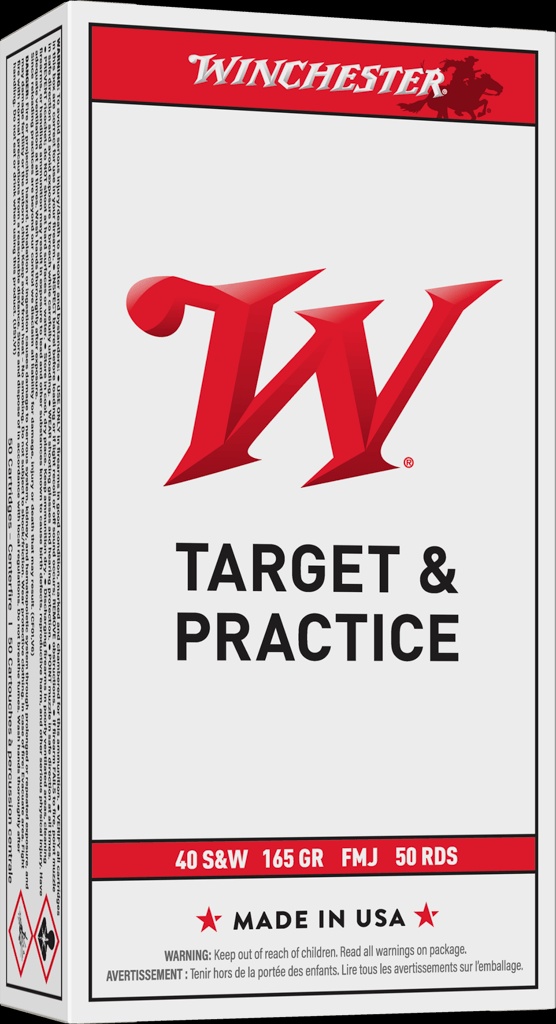
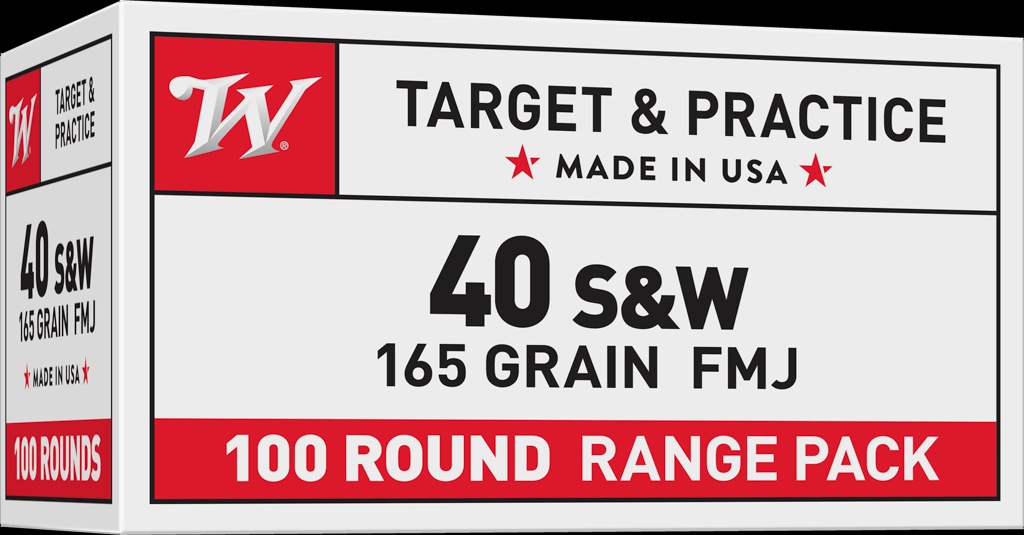
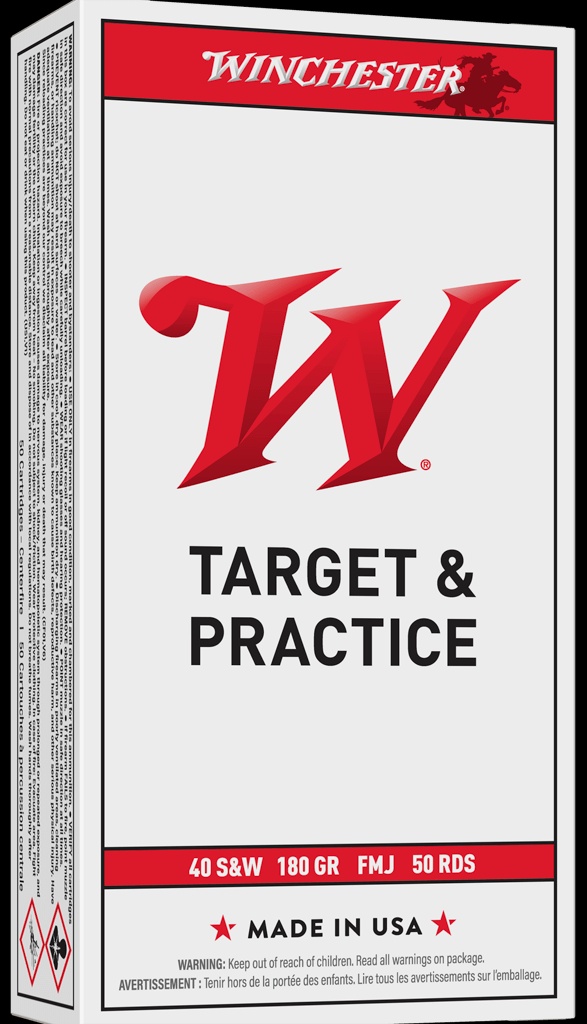
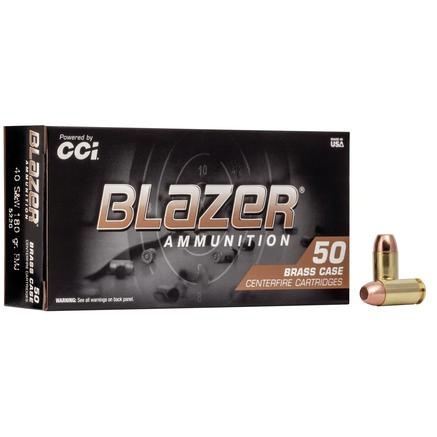
Federal American Eagle, Blazer Brass, Magtech, and Winchester White Box in 180 grain FMJ are the same loads that fed a decade of police qualification courses, and they now price close to 9mm in many weeks. The current floor for the caliber is $0.35 a round — check today’s number on the .40 S&W caliber page — and that is where the value argument lives: for the cost of a case of premium 9mm you can generally have a case of .40 and change.
What they are not: match ammunition. Minute-of-angle precision from MOA-level groups is not what a 50-cent-class FMJ promises, and .40 was never a target cartridge. They are consistent, clean enough, and cheap enough to shoot volume — which is exactly what the recoil-heavy .40 needs, because the only way to get good with it is to shoot a lot of it.
Volume also solves the .40’s one real training problem: the snappy recoil impulse that makes the front sight leave the target longer than it does in 9mm. Shooters who put 500 rounds through a .40 shoot it as accurately as they shoot a 9mm; shooters who put fifty through it flinch forever. The cheap 180 grain case is not just a budget decision — it is the mechanism by which the recoil stops being a problem.
What to carry
The defensive .40 market is a subset of the 9mm one, but the leaders are the same names: Federal HST 180 grain, Speer Gold Dot 180 grain, and Winchester Ranger-T. All three were designed around .40 velocities and are tested through clothing and barriers. Buy two boxes of one load and commit: one box for the verification run, one for the gun.
Barrel length matters more here than in 9mm. A 3.6-inch subcompact loses roughly 75 to 100 fps against a 4.5-inch service pistol, and some hollow points are tuned around velocities the short barrel never reaches. If the gun is small, look for loads the manufacturer lists at short-barrel test lengths, and run the verification from the gun you will actually carry rather than from a full-size range piece.
Common mistakes
- Buying .40 for a subcompact and hating it. The cartridge shines in 4-inch-and-up pistols. In a pocket-sized .40 the recoil makes the gun slower than a 9mm of the same size, every time.
- Ignoring point of impact shifts. A pistol zeroed for 180 grain may print differently with 165 grain. If you switch, confirm the zero — the mechanism is explained in understanding grain weight.
- Treating .40 as cheap 10mm. It is not, and the relationship runs the other way: full-power 10mm loads are a different cartridge with a different case and a different pressure level. If bear country is the actual problem, buy a 10mm pistol and a 10mm guide — not hotter .40. For the full-size pistol debate closer to home, the .45 ACP buying guide is the other half of the comparison.
- +P labels. +P .40 loads exist; not every pistol is rated for them. Check the manual before you commit to a case.
A sensible first order
- One 1,000-round case of 180 grain FMJ — the cheapest in-stock option on the caliber page, which today starts at $0.35 a round. That is the volume you need to make the snappy recoil automatic.
- Two boxes of one 180 grain hollow point for verification and duty.
- A 50-round box of 165 grain only if you want to test the lighter weight properly rather than assume.
The .40 case has no shortage of capacity for practice; the only real decision is how much of it you buy at once. The arithmetic is in when buying a case makes sense, and the shelf, sorted, is on the caliber page linked above.
Shop this caliber
Live prices from the warehouses that have it on a shelf right now.