.30 Carbine ammo buying guide
.30 Carbine exists because of the M1 Carbine and almost nothing else. The ammunition conversation is short: military-style FMJ for practice, soft points for work, and a clear answer on the self-defence folklore.
By TAS6 min read
.30 Carbine is the M1 Carbine’s cartridge and very little else’s. Buy it for the carbine, for a handful of modern handguns chambered for it, or for light pest work where a mild rifle round beats a rimfire. Ignore the forum argument about whether it is a pistol round or a rifle round: it is a light, fast 110-grain design from 1940, and the load you put in the chamber decides everything the cartridge can do.
What the cartridge is for
From an 18-inch barrel, a standard 110-grain load leaves at roughly 1,900–1,990 fps. Muzzle energy sits near 960–1,000 ft-lbs, which is more than a hot .357 Magnum revolver and far less than a .223 from the same distance. The practical character is mild recoil, a light gun, and a flat-enough trajectory for a few hundred yards of open ground.
That makes a clean two-job cartridge: inexpensive volume practice in an M1, M2 or modern semi-auto carbine, and soft-point work on small game, predators and the occasional farm problem at sane ranges. It is not a long-range hunting cartridge, and it is not a substitute for a duty handgun round in a modern service pistol.
The load menu
| Load | Weight | Velocity | Role |
|---|---|---|---|
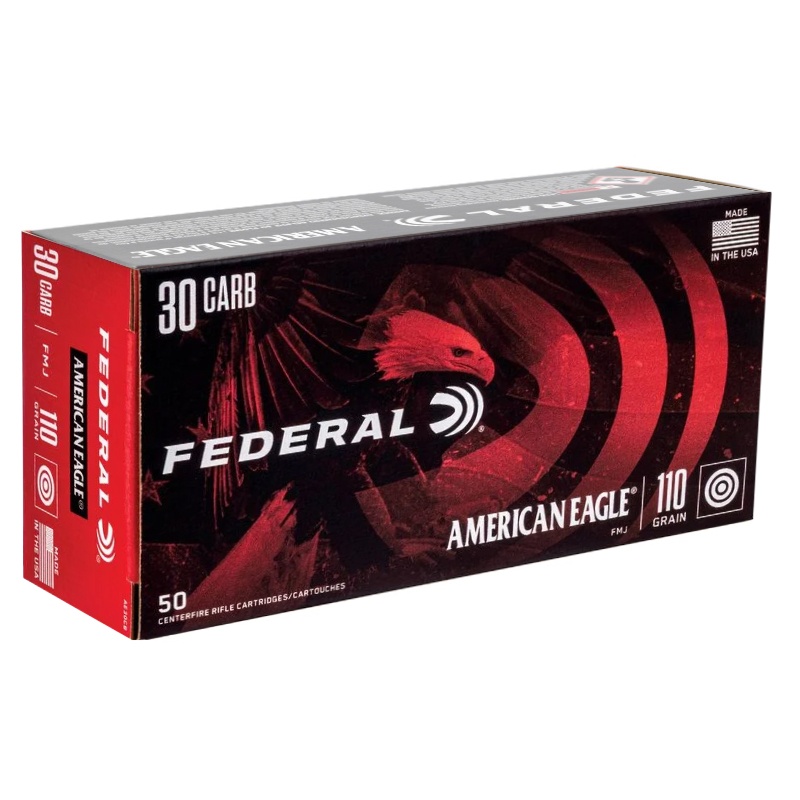
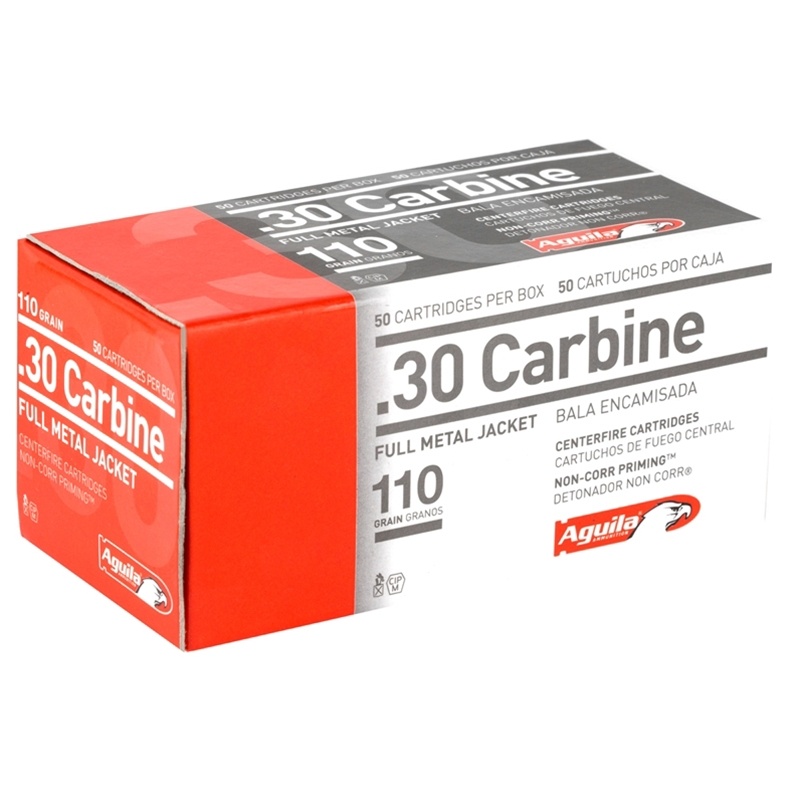
| Military-style FMJ | 110 gr | 1,900–1,990 fps | Practice, plinking, original military rifles |
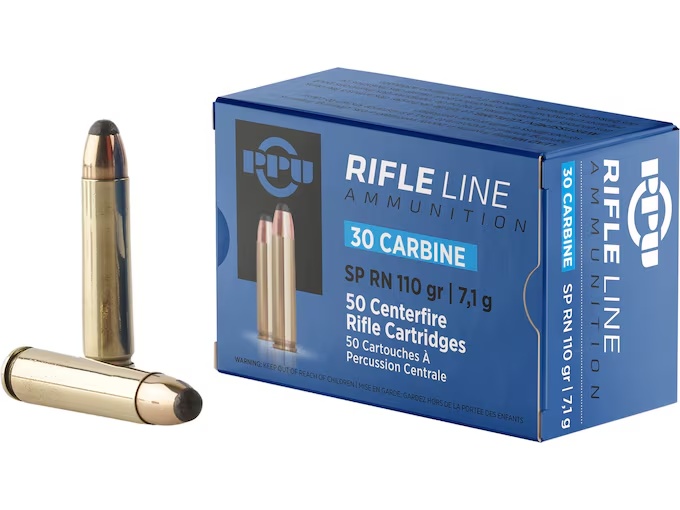
| Soft point | 110 gr | ~1,890–1,950 fps | Small game, predators, light hunting |
| Jacketed soft / bonded hunting | 110–125 gr | 1,800–1,950 fps | Coyote and similar, where expansion matters |
| Jacketed hollow point (handgun loads) | 110 gr | ~1,400–1,500 fps from a 5–6" barrel | Revolvers and pocket carbines chambered for it |
The factory shelf is thinner than 9mm or .223, but it is not empty. Federal, Winchester and Remington all keep a 110-grain FMJ in production, and soft points appear in the same catalogue each year. Cheapest current practice pricing sits around $0.64 a round on the live.30 Carbine shelf when cases are stocked; expect soft points and hunting loads to cost more.
FMJ against soft point
Full metal jacket is the original military load: a round-nose 110-grain bullet with no expansion mechanism. It is cheap, cycles in a well-kept Carbine, and punches a caliber-sized hole through what it hits. For paper, steel and high-volume practice that is exactly what you want.
Soft point exposes a lead tip designed to upset on impact. In gel and on game the difference is obvious: controlled expansion, a wider permanent cavity, and energy dumped inside the target rather than carried through a backstop. If the job is rabbits, groundhogs or a coyote at a few hundred yards, soft point is the load that does the work. FMJ is the load that misses and keeps going.
What to practise with
An M1 Carbine is happiest on consistent, correctly loaded ammunition. The rifle was designed around a 110-grain round-nose FMJ at about 1,900 fps; hotter loads or heavy hunting bullets change extraction timing and accuracy. For volume work:
- Buy brass-cased 110-grain FMJ by the case when you can. The per-round spread between brands is usually a couple of cents; the bigger win is a single load you trust for function.
- Keep a box of your chosen soft point for zero confirmation and a short verification run before hunting season.
- If you reload, the Carbine is a friendly case: simple geometry, moderate pressure, and plentiful brass from range pickups when someone else is shooting military surplus.
The reasoning behind comparing by the round rather than the box is in price per round. Volume economics for cases are covered in bulk ammo.
Handguns and the age rule
A short list of modern revolvers and single-shot pistols are chambered for .30 Carbine. From a five- or six-inch barrel you lose several hundred feet per second against an 18-inch rifle, which changes the terminal story completely. If that is your platform, buy the loads listed for handgun use and re-zero for them; do not assume rifle velocity from a revolver.
Because those guns exist, .30 Carbine ammunition is often sold under the handgun age rule even when most buyers are rifle owners. Check your state and the retailer’s policy before you order if you are under 21.
A sensible first order
- One case of 110-grain FMJ for the year’s practice. Watch the live .30 Carbine price as stock moves; when a case price is available it is almost always the better unit cost.
- Two boxes of soft point for hunting or predator work, same bullet weight as practice so point of impact stays close.
- One box of your chosen load to verify function and zero in the actual gun you will carry, from the magazines you will use.
That is a working M1 or modern carbine year: cheap trigger time, a verified hunting load, and no dependence on folklore about what the cartridge can or cannot do. For a revolver alternative with a softer recoil impulse and a multi-caliber cylinder, see .327 Federal Magnum.
Shop this caliber
Live prices from the warehouses that have it on a shelf right now.