Understanding grain weight
Grain is the first number on every ammunition box and the least explained. It is bullet weight, it is not powder, and past a certain point your barrel decides for you.
By TAS6 min read

A grain is a unit of mass: 7,000 to the pound, about 64.8 milligrams. It is an old apothecary measure that shooting kept long after almost everything else dropped it, and it is the first number printed on every ammunition box.
What changes when the number changes
Within a caliber, a chamber can only contain so much pressure, so a heavier bullet leaves the barrel slower. Everything else follows from that trade.
- Velocity falls, momentum rises. 9mm goes from about 1,180 fps at 115 grain to about 990 at 147. The heavier bullet is slower but carries more momentum for a given velocity loss downrange.
- Recoil changes character more than amount. Total impulse across the standard weights in a caliber is broadly similar; what changes is the shape of it. Light and fast feels like a snap, heavy and slow feels like a push. Which one you shoot better is individual, and the only way to find out is to fire both.
- Ballistic coefficient usually improves. Heavier bullets in the same caliber are longer, and longer bullets generally carry a higher BC: they hold velocity better and drift less in wind, even though they start slower and drop more at the same distance.
- Point of impact moves. This is the one that catches people.
Point of impact, and why heavier often shoots higher
A heavier, slower bullet spends longer in the barrel. During that time recoil has already begun rotating the muzzle upward, so the bullet exits at a slightly higher angle. With fixed sights, switching from 115 grain to 147 grain 9mm commonly moves the group an inch or two up at 25 yards. In rifles the effect is smaller in angular terms but very visible at distance.
The practical rule: zero for the load you are going to shoot, and re-verify whenever you change weight. Nothing about this is a defect (it is geometry), but a carry gun zeroed for one load and fed another is a real miss at a real distance.
Twist rate: the constraint that actually binds
For rifles, personal preference stops at whatever your barrel will stabilise. Rifling twist is expressed as one turn in so many inches (1:7 means one full rotation every seven inches), and a faster twist spins the bullet harder.
The important and frequently misstated part: twist stabilises a bullet by its length, not its weight. Weight is simply the proxy printed on the box, and it is a decent one within a bullet family, but a long copper monolithic can need more twist than a lead-core bullet twenty grains heavier, because copper is less dense and the bullet is therefore longer.
| Caliber | Twist | Comfortable range |
|---|---|---|
| 5.56 / .223 | 1:12 | 40–55 gr |
| 5.56 / .223 | 1:9 | 55–69 gr |
| 5.56 / .223 | 1:8 or 1:7 | 55–77 gr and heavier |
| .308 Win | 1:12 | Up to about 168 gr |
| .308 Win | 1:10 or 1:8 | 175 gr and heavier |
An under-stabilised bullet announces itself. Groups open far beyond what the rifle normally does, and holes in paper are oval or sideways: keyholing, which means the bullet is tumbling before it arrives. If you see that, the answer is a lighter or shorter bullet, not a better rest.
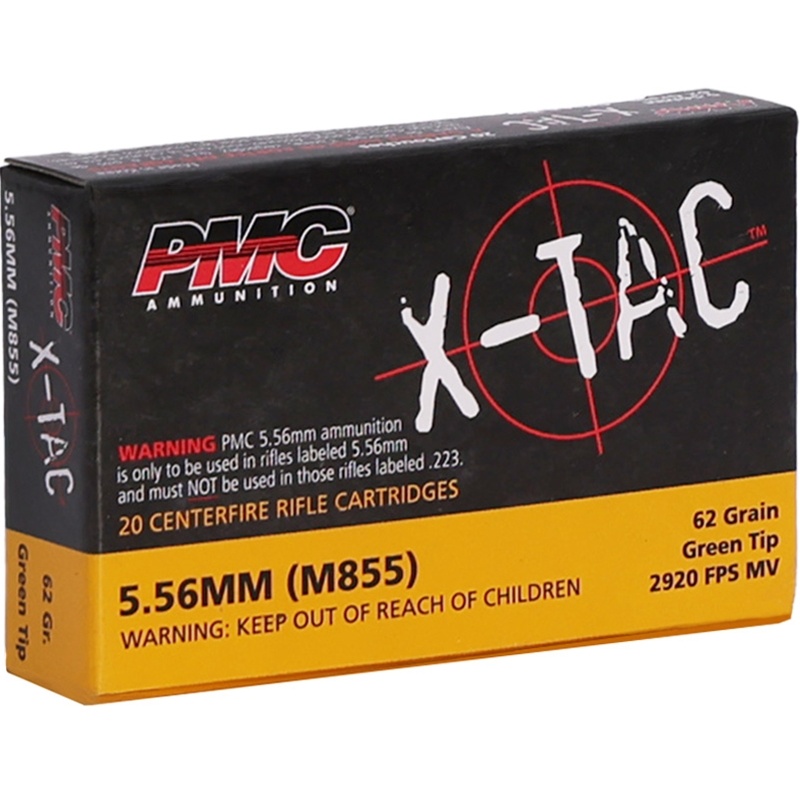
This is the entire reason black-hills-77gr-tmk-5-56-nato specifies 1:7 or faster while federal-xm193-5-56-nato at 55 grain shoots correctly out of essentially every AR barrel made. At n/a a round against n/a, the heavy match load is not the default choice: it is the choice you make when the barrel can use it and the distance justifies it. The rest of the 5.56 NATO and .223 question, including the chamber issue, is in 5.56 vs .223.
Choosing, by what you are doing
- Handgun practice. Buy the cheapest weight that runs, which is nearly always the lightest. federal-american-eagle-9mm-luger at n/a in 115 grain. Match the weight to your carry load if you can afford to.
- Handgun carry. Weight matters less than bullet construction. A well-designed 124 grain hollow point and a well-designed 147 grain hollow point are both fine; a poorly designed one in either weight is not.
- Suppressed shooting. Subsonic is the requirement, and in 9mm that means 147 grain. Supersonic ammunition through a suppressor still cracks.
- Rifle practice. Whatever your twist likes and your budget allows: 55 grain in 5.56, 147 grain FMJ in .308.
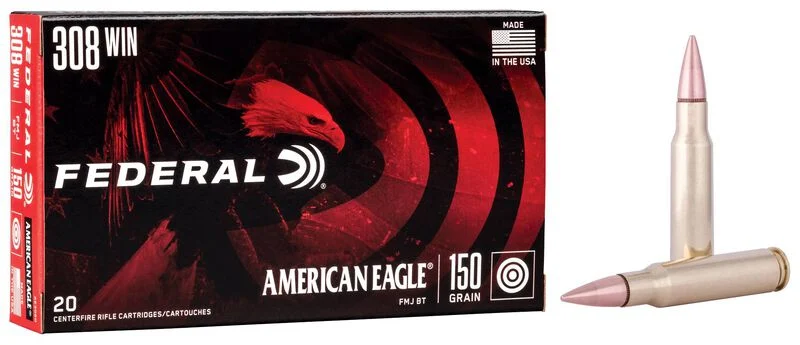
- Rifle precision. Heavy-for-caliber match bullets, if the barrel will spin them. federal-gold-medal-match-308-winchester in 168 grain has won more across-the-course matches than anything else, and its 175 grain sibling exists for barrels and distances that want it.
- Hunting. Bullet construction first, weight second. Check your state’s rules; some require non-lead, which changes the length-to-weight relationship and therefore your twist maths.
The two-box test
Everything above narrows the field; it does not pick the load. Buy a box of two candidate weights, shoot five-shot groups off a rest at a distance that means something to you, and look at the paper. A rifle that shoots one load noticeably better than another is telling you something no specification sheet will, and it costs about forty dollars to find out.
Then, once you know, buy that load in quantity, and compare it per round, not per box.
Shop this caliber
Live prices for what is in stock right now.