.22 WMR ammo buying guide
.22 WMR is not a bigger .22 LR: it is a higher-pressure cartridge that will not fit a .22 LR chamber, and it earns its keep at 100 to 150 yards where the short rimfire runs out.
By TAS6 min read
.22 Winchester Magnum Rimfire — .22 WMR, .22 Magnum, or just Magnum — is the rimfire you graduate to when .22 LR runs out of energy somewhere past 75 yards. It is the right cartridge for coyotes, groundhogs and small game at modest range, and it is a compromise cartridge for personal defence that some shooters choose deliberately for the volume of fire it allows. The ammunition decisions are about barrel length, bullet construction, and not confusing it with the short cartridge it is often sold next to.
Velocities depend on barrel length more than people expect
Published .22 WMR velocities come from a 24" test barrel, and most rifles and essentially all handguns are shorter than that. A 40 grain load that prints 1,875 fps on the box will commonly print 1,700–1,750 fps from a 16" barrel, and something closer to 1,500 fps from a 6" revolver barrel. The 30 and 32 grain loads start higher — 2,100+ fps in a test barrel — and lose proportionally more.
| Weight | Test-barrel velocity | Bullet | Best at |
|---|---|---|---|
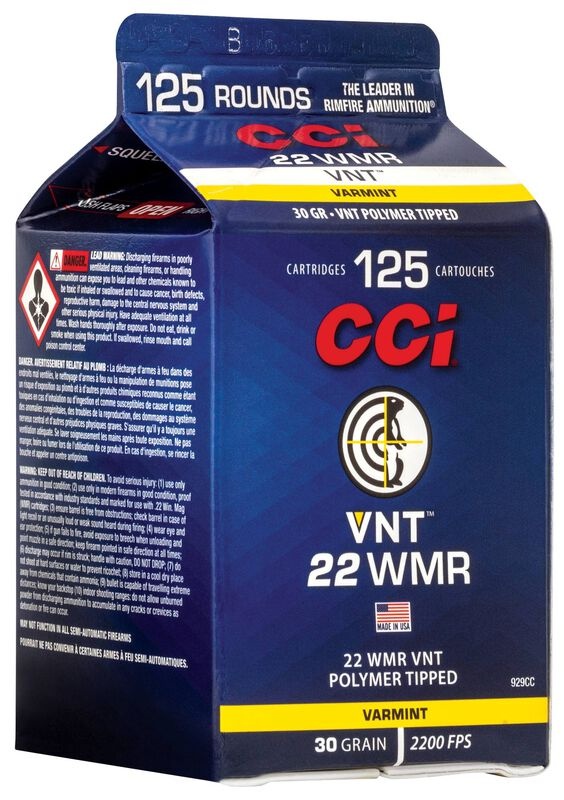
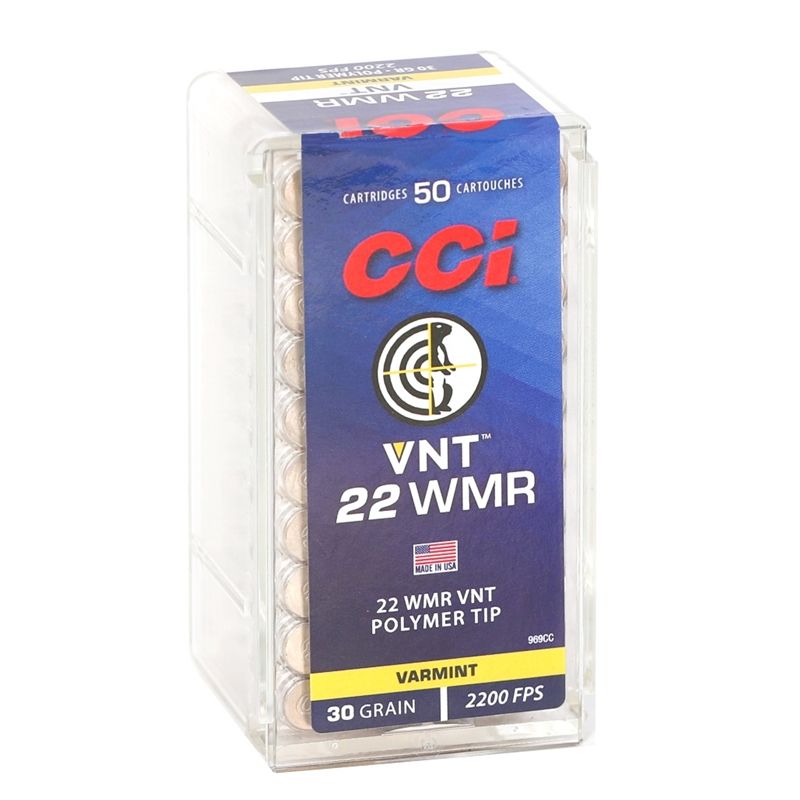
| 30–32 gr | 2,050–2,150 fps | Polymer tip, V-MAX style | Varmints, flatter trajectory |
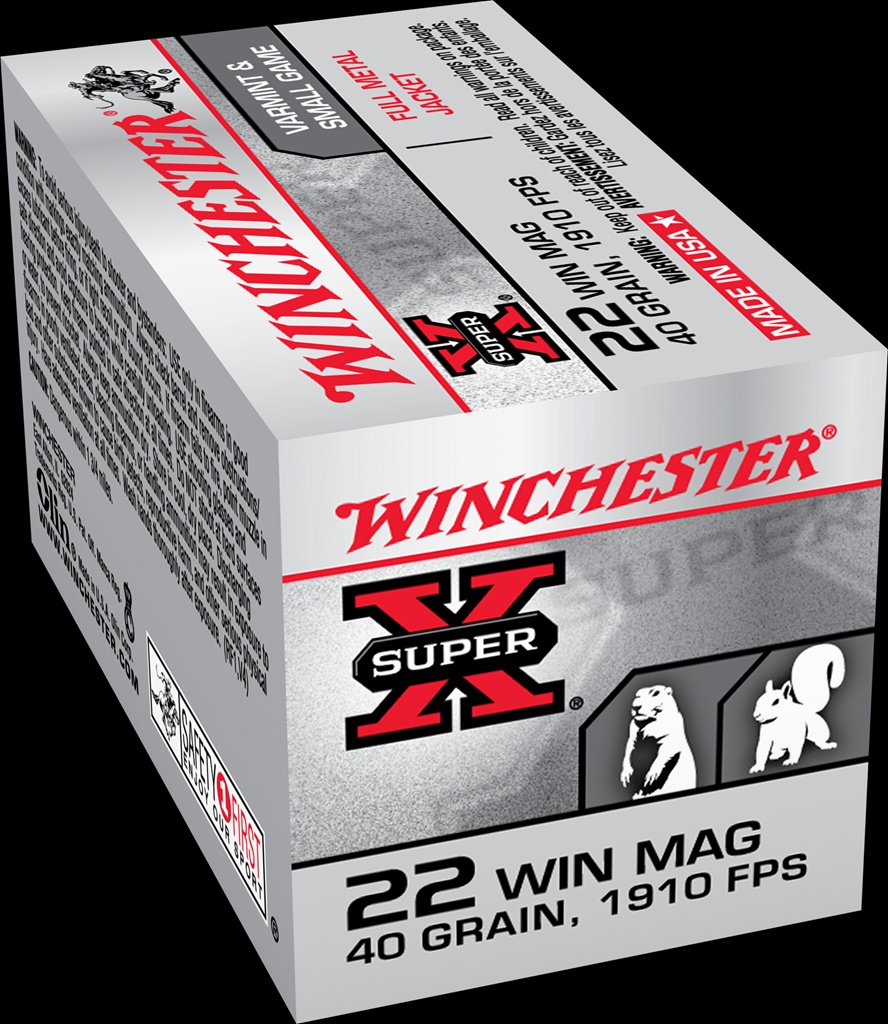
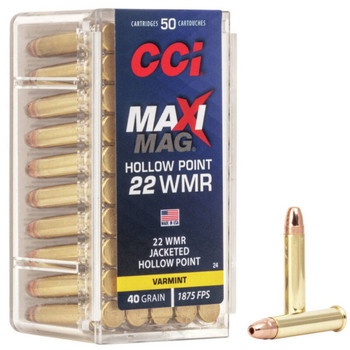
| 40 gr | 1,850–1,900 fps | Jacketed hollow point | Coyotes, small game, all-around |
| 45 gr | 1,800–1,850 fps | Heavier JHP, soft point | Heavier varmints, wind |
The practical consequence: zero for your barrel, not for the box. If you are switching between a 30 grain varmint load and a 40 grain coyote load in the same rifle, confirm point of impact for both — the difference is routinely an inch or more at 100 yards, and it is not a quality problem.
What to buy for what
For coyotes and small game, a 40 grain jacketed hollow point is the versatile default; step to a 30–32 grain polymer tip when you want a flatter trajectory and more explosive expansion on light varmints. The 45 grain loads give a little more wind tolerance for longer shots across a field.
For a lever-action or bolt gun, none of this has to feed reliably from a magazine, so accuracy is the only filter. For a semi-auto, buy a box and test: modern .22 WMR is far more reliable in semi-autos than the cartridge’s reputation from the 1970s, but it is not universal, and a box spent finding out is cheaper than a case spent regretting.
Revolvers are the other common platform, and they have their own wrinkle: .22 WMR is a rimmed cartridge, and some revolvers will shoot it and some will not, depending on cylinder dimensions and the manufacturer’s chambers. Read the manual, and buy a box before you commit to a case for a revolver you have not tried it in.
The cheapest in-stock price on the .22 WMR page is currently $0.22 a round. That is roughly two to three times .22 LR practice ammunition — which is why most serious rimfire volume still happens on a .22 LR, and the Magnum comes out when the range or the animal demands it.
The self-defence niche, honestly
Some shooters carry .22 WMR in small revolvers for the volume of fire the platform allows: five or six shots of a cartridge that is ballistically a step above .22 LR, in a gun that is pleasant to shoot and easy to conceal. That is a real use case and it deserves a straight answer rather than a dismissal.
The honest limitation is the same as every rimfire: no expansion mechanism you can rely on. The bullets fragment or deform inconsistently, and the cartridge does not produce the wound channel a modern 9mm hollow point does. If a centerfire is an option, take it. If it is not — recoil sensitivity, concealment, or a medical constraint — a .22 WMR with a 40 grain hollow point, practised with, beats the .22 LR it replaces and beats a centerfire you will not shoot.
The ammunition choice in that role is simple: a 40 grain jacketed hollow point from a reputable manufacturer, with enough of it on hand to practise and to verify cycling in the revolver or pistol you carry. Do not carry the polymer-tipped varmint loads for defence; they are designed to fragment on light animals, and that is the opposite of what you want here.
The broader argument, with the gel data and the capacity-versus-mass trade, is in 9mm vs .45 ACP, which applies the same reasoning to the two most common defensive calibers. For the short rimfire that sits below this cartridge, see the .22 LR buying guide.
A sensible first order
- One box each of 30 and 40 grain to establish which your rifle shoots better and where each one prints.
- 100 rounds of whichever won for practice and zero confirmation.
- Two boxes of the coyote load once the season or the reason to own the cartridge is clear. Rimfire ammunition is not perishable on a hunting-season timescale; buy for the year, not the decade.
Sorted by bullet weight and intended use, the shelf is on the .22 WMR caliber page. If you are trying to decide whether the step up from .22 LR is worth it for your particular rifle, understanding grain weight covers why a heavier bullet at lower velocity can outperform a lighter one at higher velocity past a certain distance.
Shop this caliber
Live prices from the warehouses that have it on a shelf right now.