6.5 Creedmoor ammo buying guide
6.5 Creedmoor is a match cartridge with a hunting side, not a hunting cartridge with a match load. Buy it for the factory match ammo, then pick a hunting bullet for the season.
By TAS6 min read
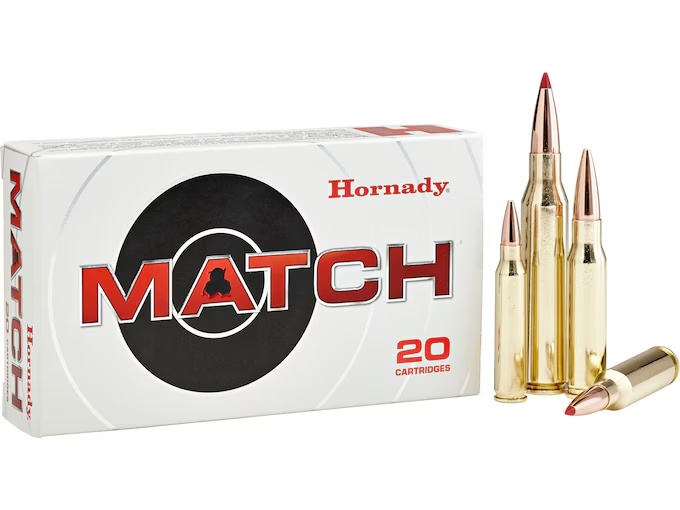
6.5 Creedmoor exists because of its ammunition, not the other way around. Hornady designed a cartridge around long, high-BC bullets seated out to the freebore that precision shooters wanted, and the factory match load that resulted turned out to be good enough that ordinary rifles started shooting like competition rifles. The buying decision is therefore mostly a match-availability decision, with a hunting load bolted on for the season.
Why 140 grain is the default
The Creedmoor’s personality lives in the 140 to 147 grain class of bullets: long for their weight, with high ballistic coefficients because of the 6.5mm (.264") diameter’s slim profile. A typical 140 grain factory match load leaves the muzzle at about 2,700 fps from a 24" barrel and stays supersonic well past 1,000 yards — and more to the point, it drifts less in a crosswind at 600 yards than a 168 grain .308 does, out of a rifle with about a quarter less recoil.
| Weight | Velocity | Bullet | Best at |
|---|---|---|---|
| 140 gr | 2,650–2,700 fps | Match hollow point | Precision fire, 100–900 yards |
| 143 gr | 2,650–2,700 fps | Hunting, controlled expansion | Deer and antelope, any sensible range |
| 147 gr | 2,575–2,625 fps | Long-range match | Wind-heavy courses, 600+ yards |
| 127–130 gr | 2,800–2,900 fps | Lighter hunting | Smaller game, flatter short trajectories |
The price signal matters: at the cheapest in-stock price of $1.24 a round on the 6.5 Creedmoor page, factory match ammunition is usually priced only a little above .308 match — and often below it, once you account for the fact that the Creedmoor load you are buying is the one the cartridge was designed around rather than a concession to a legacy chambering.
Hunting bullets: the load menu gets thinner, and that is fine
The Creedmoor’s hunting menu is smaller than .308’s but it is not thin in any way that matters for deer-sized game. A 143 grain controlled-expansion bullet is the default for elk-sized animals and a comfortable overmatch for deer, and the polymer-tipped and monolithic options in the same weight class give you a choice of how aggressively you want the bullet to open.
If you hunt smaller game or want a flatter short-range trajectory, the 127–130 grain class is available and worth a look. What you will not find is a genuine 180+ grain heavy-game option: the bore is .264 inches and the case is a short action, and that is the ceiling. If your hunting plan includes elk at long range, this is still a credible cartridge — but you are choosing a good bullet over a heavy one, and that trade deserves a conscious decision.
What to practise with
Factory match is the product that made the cartridge, but shooting it for every trigger pull is expensive. The middle path most Creedmoor owners land on: a training-grade 140 grain load for volume— usually a plain FMJ or a lightly held match bullet — and a box or two of premium match for the sessions where you are measuring the rifle rather than yourself. The point of impact difference between the two is often small but it is rarely zero, so confirm your hunting zero with the hunting load rather than assuming the training load prints the same.
Twist rate in factory Creedmoor rifles is almost always fast enough for the long 140–147 grain bullets — 1:8 is the common standard — so bullet weight is not a compatibility question the way it is in some AR barrels. What does matter is seating: these are long bullets seated out to magazine length, and jump-to-lands is the variable that will change your groups most once you start reloading. Until then, factory ammunition and a good scope will show you what the rifle can do.
The cost of entry against .308
.308 Winchester still wins on shelf depth and, usually, on case-priced practice ammunition. The Creedmoor wins on what you can do with a 20-round box of factory match out of an ordinary rifle. The honest comparison looks like this:
- Practice cost. .308 147 grain FMJ is almost always cheaper by the case. If you shoot 2,000 rounds a year, that gap is real money.
- Match cost. Factory 140–147 grain match is competitively priced against .308 match, and you get more performance per dollar at distance.
- Recoil. Roughly a fifth to a quarter less, depending on load. That is a practice advantage as much as a comfort one: you will shoot more and flinch less.
- Barrel life. Both last thousands of rounds; the .308 has a slight edge under match-grade volume fire, and for most shooters the difference is academic.
For the full picture, including the wind-drift and trajectory numbers, see the comparison we have already published on .308 Winchester, and the cost-of-entry reasoning in price per round. If you are coming from a short-range hunting rifle and want to understand the recoil and terminal-performance trade more generally, the grain-weight explainer is understanding grain weight.
A sensible first order
- Two boxes of 140 grain factory match to establish what the rifle will actually do. Shoot one for groups, keep one for zero confirmation before season.
- Two boxes of your chosen 143 grain hunting load, so you can verify point of impact with the ammunition you will carry.
- 100 rounds of cheaper 140 grain FMJ or training match for positional practice. The Creedmoor rewards trigger time more than it rewards a more expensive bullet.
The full shelf, including current match-load pricing, is on the 6.5 Creedmoor caliber page. If you are deciding between this and .300 Blackout for a different kind of rifle, the .300 Blackout guide covers a cartridge with a completely different job.
Shop this caliber
Live prices from the warehouses that have it on a shelf right now.