.223 Remington ammo buying guide
Commercial .223 and NATO 5.56 are different pressure standards in nearly identical brass, and the chamber in your rifle decides which box you should buy. The rest is varmint loads and practice volume.
By TAS6 min read
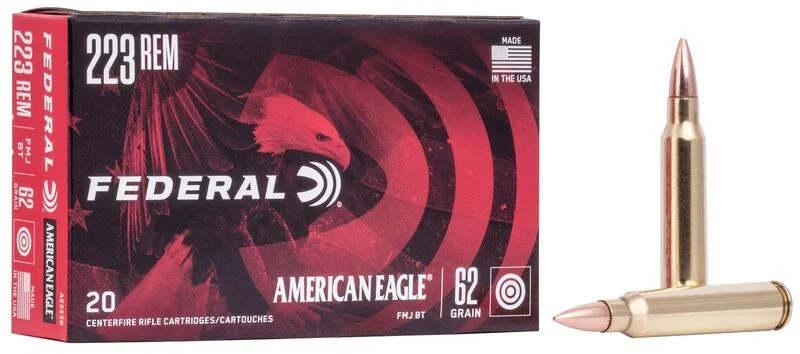
.223 Remington is the commercial twin of 5.56 NATO: same bullet diameter, same case family, different pressure standard and a different throat. The buying decision people get wrong is assuming the boxes are interchangeable in every direction. The chamber in your rifle decides what you should buy, and once that is settled, .223 splits into three practical menus — cheap practice FMJ, varmint loads with light expanding bullets, and the occasional box of heavier match — which are easier to shop than the 5.56 shelf because the military-surplus noise is absent.
The one-way rule to memorise: a 5.56 or .223 Wylde chamber will safely fire both .223 and 5.56 ammunition; a tight commercial .223 chamber should be fed commercial .223 only. If the barrel stamp is ambiguous, read the 5.56 vs .223 comparison before you buy military-pressure ammo.
What .223 Remington is for
The cartridge arrived in 1964 as the civilian sporting version of the military AR-15 round, and it never left the centre of the American rifle market. Today it fills three jobs: AR-15 practice and general shooting, varmint and predator hunting with light, fast expanding bullets, and bolt-gun target work in rifles chambered specifically for it. Velocities from a 16-inch barrel run 3,200 to 3,300 fps with 55-grain practice loads; from a 20- or 24-inch varmint barrel, 50- to 55-grain loads can exceed 3,400 fps.
The recoil is negligible, the rifles are everywhere, and the ammunition is among the cheapest centerfire rifle rounds on the shelf. For the AR-side volume discussion, the 5.56 buying guide covers the military-adjacent market; this page is the commercial cartridge and the chambers that actually cut it.
The load menu
| Load | Velocity | Character | Best at |
|---|---|---|---|
| 55 gr FMJ | 3,200–3,300 fps | The default practice load | Volume, steel, general shooting |
| 50–55 gr soft point / polymer tip | 3,300–3,600 fps | Fast, lightly constructed | Varmints and predators |
| 68–77 gr OTM / match | 2,750–3,050 fps | Heavier, higher BC, twist-dependent | Precision; 1:8 and faster twists |
| 52–55 gr match | 3,150–3,300 fps | Target-grade in the classic weight | Bolt-gun benchrest-style work |
Commercial .223 versus NATO 5.56
The two specifications share a cartridge outline but not a pressure or throat. Commercial .223 Remington is a SAAMI-standardised cartridge at a lower maximum pressure and with a shorter throat than the military chamber; 5.56 NATO runs a higher pressure standard and a longer throat designed around the 62-grain military bullet and the rougher maintenance cycle of service rifles.
The practical rules that follow:
- .223 ammunition in a 5.56 or Wylde chamber: always safe. Lower pressure, shorter throat — the gun will simply group wherever it groups.
- 5.56 ammunition in a commercial .223 chamber: the questionable direction. The longer throat changes headspace and the higher pressure standard is outside what a commercial .223 chamber was proofed for. Many rifles will fire it without complaint; the argument is that you should not need it to.
- .223 Wylde: a hybrid chamber that safely handles both at commercial accuracy levels. If the barrel says Wylde, buy whichever is cheaper on the day.
None of this is a reason to panic; it is a reason to read the barrel stamp once and buy accordingly for the life of the rifle. The expanded version of this argument is the comparison post.
The varmint side of the cartridge
This is the half of the .223 market the AR practice crowd ignores and the bolt-gun crowd lives in. Light bullets — 50 to 55 grains, polymer tipped or soft pointed — are loaded to high velocity specifically so they fragment quickly on impact, which is the correct terminal behaviour for coyotes, groundhogs, and similar game and the wrong behaviour for anything you intend to eat or anything large. The trajectory advantage at 200 to 300 yards is significant: a 55-grain practice load and a 50-grain varmint load may differ by a foot of drop at 300 yards, which is enough to matter on a small animal.
If varmint hunting is the actual job, buy a box of premium polymer tips (Federal, Hornady, Nosler, and Winchester all load credible variants) and zero for that load specifically. The lighter the bullet, the more point of impact will move relative to practice FMJ — the mechanics are in understanding grain weight, and the grouping target you are aiming at is described in minute of angle.
Common mistakes
- Feeding a commercial .223 chamber military-pressure ammo because the boxes look identical. They are not. Read the barrel, then the box.
- Assuming 55 grain practice FMJ will hunt. Full metal jacket is the wrong construction for game in most states and is a poor terminal performer besides. Buy the soft point.
- Ignoring twist on heavy match loads. A 1:12 varmint barrel will not stabilise a 77-grain bullet; a 1:7 AR will shoot anything. The barrel stamp settles this too.
- Buying varmint ammo for volume. Premium polymer tips cost two to three times FMJ and are built for a job the range does not require. Practice on 55 grain; verify with the hunting box.
- Treating steel-cased .223 as banned everywhere. Same rule as 5.56: some rifles eat it happily, many ranges will not take it, and one test box resolves both questions.
A sensible first order
The commercial floor for the caliber is $0.48 a round on the .223 Remington caliber page — usually a brass 55 grain FMJ, occasionally steel if your rifle and your range both tolerate it.
- One 500-round case of 55 grain FMJ — practice ammunition, bought by the case because that is where the per-round price lives. The case arithmetic is in when buying a case makes sense.
- One 20-round box of your hunting or match load — polymer-tip varmint if the rifle is a predator gun, 68- to 77-grain match if it is a precision AR — to verify zero and function before the season or the competition.
- Nothing else until the first two are shot and recorded. Most .223 owners own more kinds of ammunition than kinds of data on their own rifle.
Chamber stamp, twist rate, one case of practice, one box of the purpose load, and a written record of where each prints — that is the whole system. When the question grows past the varmint fields, the short-action step up is in the .308 buying guide; the cartridge’s military sibling stays in the 5.56 guide above.
Shop this caliber
Live prices from the warehouses that have it on a shelf right now.